The job it does
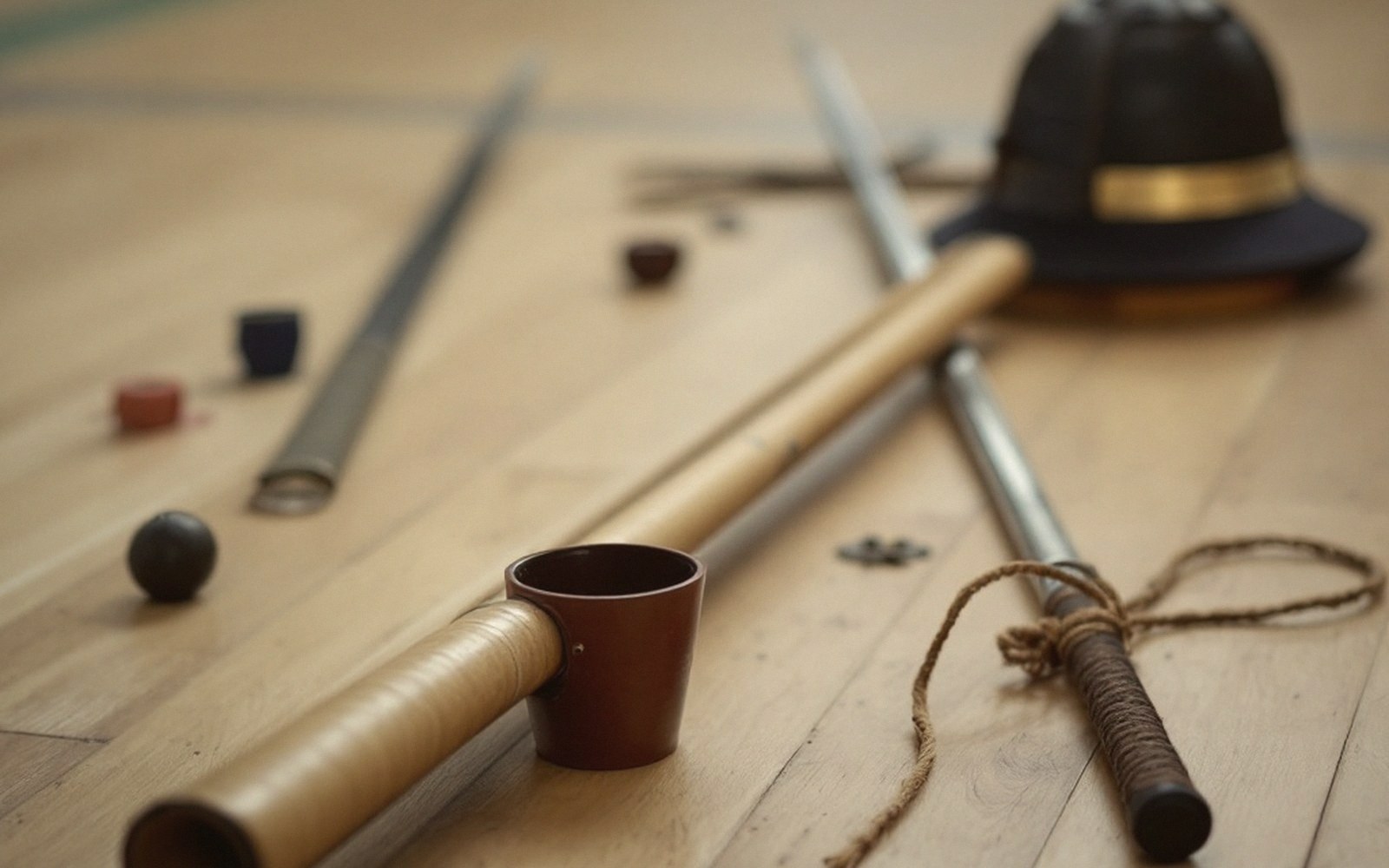
Every strike drives the four staves of a shinai forward and stops them abruptly. The tip — sakigawa in Japanese — is the single component holding those stave-ends together at that moment of arrest. Without it, the bundle opens like a flower.
The cap is a shallow cup of tanned leather, stitched or folded at its rim and pulled tight over the top few centimetres of the staves. It works partly by compression — the leather grips the bamboo when the fit is correct — and partly because the tsuru (the cord running the length of the back stave) loops through a notch in the cap's edge and keeps it seated under constant tension. Loosen the cord and the cap begins to work free; let it work free and the tip geometry shifts, the staves lose registration with one another, and the whole assembly becomes dangerous to use.
The leather must be stiff enough to resist the shear load of a strike, yet not so rigid that it cracks when the bundle flexes on impact. Traditional caps are cut from a single piece of vegetable-tanned hide, dampened, formed over a mandrel close to the stave diameter, and allowed to dry into shape. The dome that results is not decorative — it is a controlled curve that distributes load away from the sharp edges of the cut bamboo beneath it. A flat cap would concentrate stress at four corners; the dome spreads it.
Fit is everything. A cap that is even slightly too wide will spin under load, exposing a gap at one side. Too tight, and fitting it without splitting the leather requires patience — dampening the leather again, working it slowly over the tip with steady thumb pressure rather than force. The diameter of a replacement cap must match the stave assembly, not some notional standard, because four pieces of split bamboo are never perfectly uniform.
A worn cap shows its age clearly: the dome flattens, the leather thins at the crown, and small radial cracks appear around the cord notch. Any of these is reason to replace it before the cord works free. The cap is among the least expensive parts of a shinai and among the most consequential to neglect.