The shinai itself
Shinai (竹刀) means, literally, bamboo sword, and it names the whole assembly — but the word stops being useful the moment you need to describe what has failed. From there, you need the part names, and they are all Japanese.
The four split-bamboo slats are take (竹), sometimes called staves in English; each one runs the full striking length and tapers toward the tip. Together they form the body of the weapon. The wide flat face of each stave, the surface that faces inward and touches its neighbours, is the hira (平); the narrow outer edge, the convex surface you see from outside, is the mune (棟). A crack that opens on the mune matters immediately. One that shows on the hira matters too, but the geometry is different, and so is the repair decision.
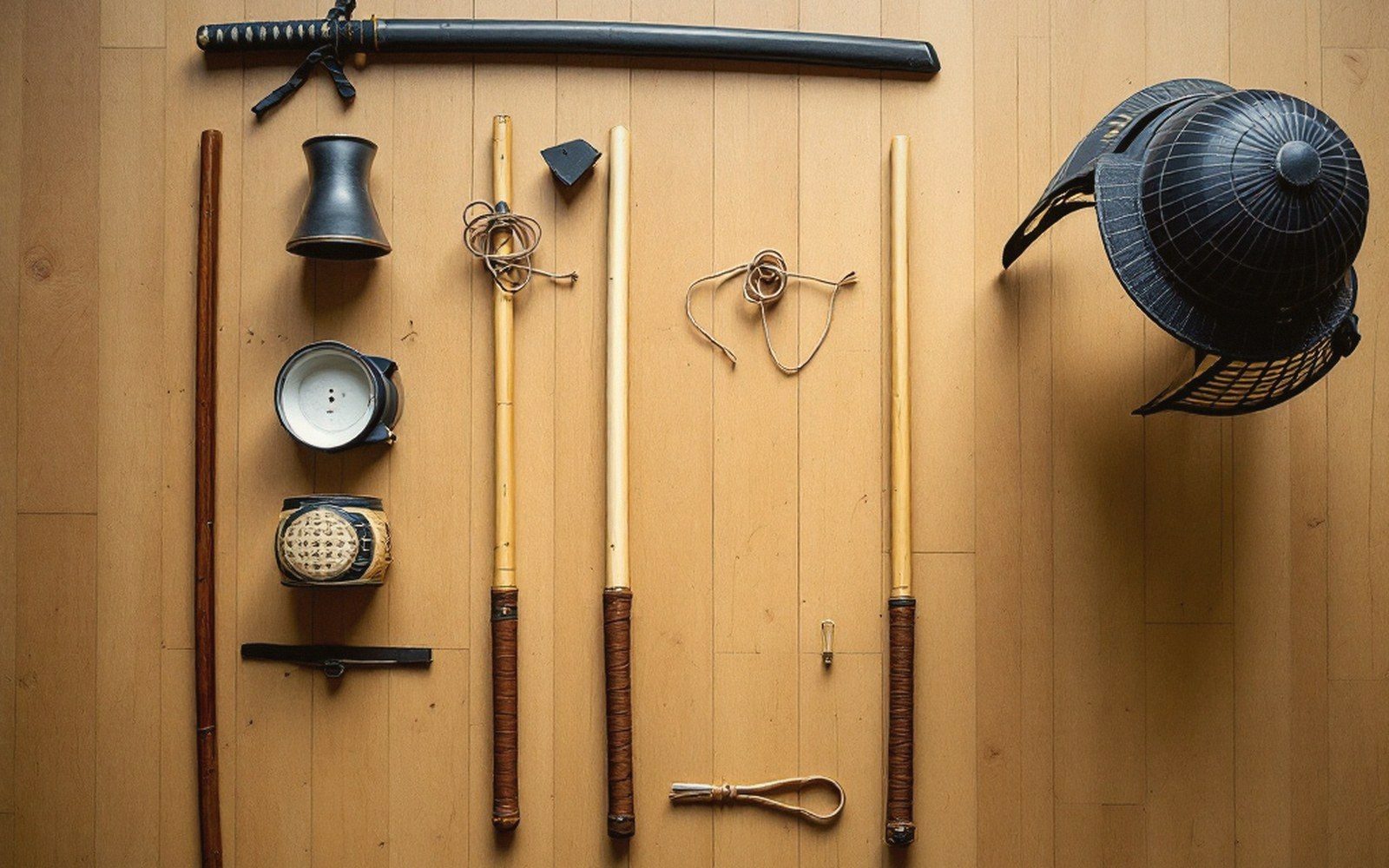
At the thick end, the four staves are held together by the tsuka (柄), the grip, a wooden core wrapped in ray-skin or synthetic substitute and then bound with cord. The tsuka-gawa (柄革) is the leather or leather-like sleeve that fits over that core; it is what actually wears, what your hand reads, and what is replaced when the surface breaks down. Just above the grip, sitting at the boundary between handle and blade, is the tsuba (鍔) — the hand-guard, a flat disk of rubber or leather — and the tsuba-dome (鍔止め), the small rubber collar that keeps the tsuba from sliding.
Tip to tail
Moving up from grip to tip: the nakayui (中結い) is a leather binding wrapped around the staves at roughly a quarter of the striking-length from the tip. It is not decorative. The nakayui holds the four staves in close contact at the point where a strike lands, and its exact position is measured, not estimated. A nakayui that has crept toward the tip or slipped back toward the grip changes the flex of the striking zone and the feel of impact — and it will fail inspection.
At the far end, the staves converge inside the sakigawa (先革), the leather tip-cap: a cup sewn or folded from a single piece of hide that gathers all four stave-ends and holds the assembly closed. Inside the sakigawa and between the stave-ends sits the saki-gomu (先ゴム), a small rubber plug that keeps the cap from collapsing inward on impact and cushions the contact. Both parts are consumables; the sakigawa in particular should be inspected every session, because a split cap can expose the stave-ends and immediately takes the shinai out of service.
Running down the spine — along the mune side of one stave, from sakigawa to tsuka — is the tsuru (弦), the cord. It does several things at once: it defines the back of the weapon (the side that must not strike), keeps the staves from splaying, and maintains the pre-tension that gives the assembly its characteristic flex. A slack tsuru is not a cosmetic problem. The geometry of the whole instrument depends on it being taut.
Why precision matters
Repairers who work across language barriers quickly find that approximate translations lose information. "The leather bit at the top" could be the sakigawa or the tsuka-gawa; "the cord" does not say where it has failed or what tension it should carry. The Japanese terms are precise in a way that English workarounds are not: each name points to exactly one component, one function, one failure mode. Learning them is not a matter of tradition. It is a matter of accuracy — the same reason a joiner knows the difference between a mortise and a tenon rather than calling both of them "the wooden part that connects things."