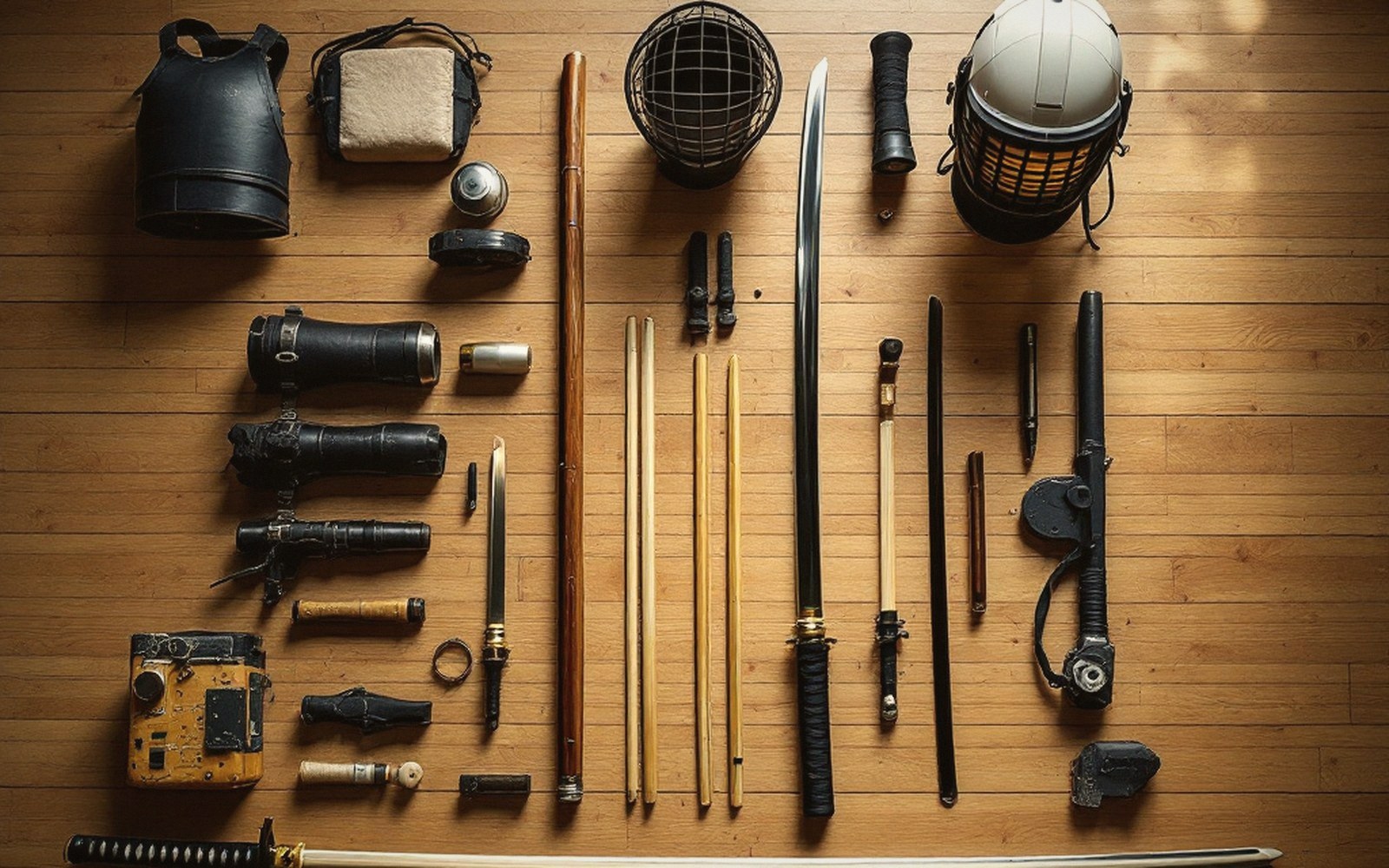
What you are looking for
Inspection is not a ritual — it is a diagnostic. Every shinai that has been struck against another, or stored badly, or simply aged, carries a small inventory of developing faults. Most are invisible at a glance. The point of a structured check is to surface them before they matter, because a stave that splinters mid-swing does not fail gracefully.
Begin with the four staves — the take (bamboo slats) themselves. Run your thumb and forefinger down each face, rotating the shinai a quarter-turn between passes. You are feeling, not just looking: a developing crack often shows as a roughness or a faint ridge before it opens wide enough to catch the eye. Any split that runs longitudinally along the grain, any raised sliver, any fibre that is lifting away from the surface — that stave is out. The risk is not cosmetic. A splintering stave can pass fragments through a grille or drive bamboo into a glove at striking speed, which is why the check is not optional.
Pay particular attention to the striking zone, roughly the upper third of the shinai. This is where compression loads are highest and where surface fibres fail first. But do not ignore the lower section: a crack near the base of a stave, close to the grip, can propagate quickly under repeated flex. Nodes — the hard, ringed interruptions in the bamboo's grain — deserve a separate look. A node that has shifted visibly out of plane, or that shows a circumferential crack running around rather than along the stave, is a structural failure, not surface damage.
The cap, the cord and the knot
Once the staves pass visual and tactile check, move to the components that hold them together. The leather sakigawa (tip cap) sits over the striking end and keeps the four staves aligned at the point of highest impact. Press it firmly: it should be seated hard against the staves with no lateral play. If it can be rocked side to side, the staves inside have either compressed or dried and shrunk away from it — either way, the assembly needs attention before use. Inspect the leather itself for cracking along the rim and for any breach in the stitching.
The tsuru (cord) runs down the back of the shinai from cap to grip, and its tension is load-bearing, not decorative. A cord that can be lifted more than a few millimetres from the surface is too slack, and a slack cord changes where the staves can move relative to each other under strike. Check also for fraying, particularly where the cord passes through the cap and where it ties at the guard. Either point concentrates wear. The nakayui (binding tape) at the upper quarter of the shaft is checked for secure seating and even tension; it should not be able to slide.
The tsukagawa (grip leather) comes last. Grip inspection is partly about the leather's condition — cracking, delamination, areas that have compressed to a slick gloss — and partly about security: a grip that has worked loose will rotate under the hand, which is a handling problem, not just a cosmetic one. Check the collar at the top of the grip where it meets the guard for separation.
The sequence matters
Order is not arbitrary. Starting at the staves and working from the tip toward the grip means you are examining from highest-consequence failure to lowest. A destroyed tip cap and a loose grip are both faults; the destroyed cap is the one that puts someone at risk immediately. Working in the same direction every time also means you do not skip sections. The whole pass, done methodically, takes perhaps two minutes per shinai. Over a session, over a season, the time is trivial against what it finds.
A shinai that fails this check comes off the rack. It does not get a temporary pass because no spare is available. Repair or retire it — those are the only two outcomes.
Four Staves is an independent publication about kendo equipment and craft. It is not a federation, dojo or retailer.