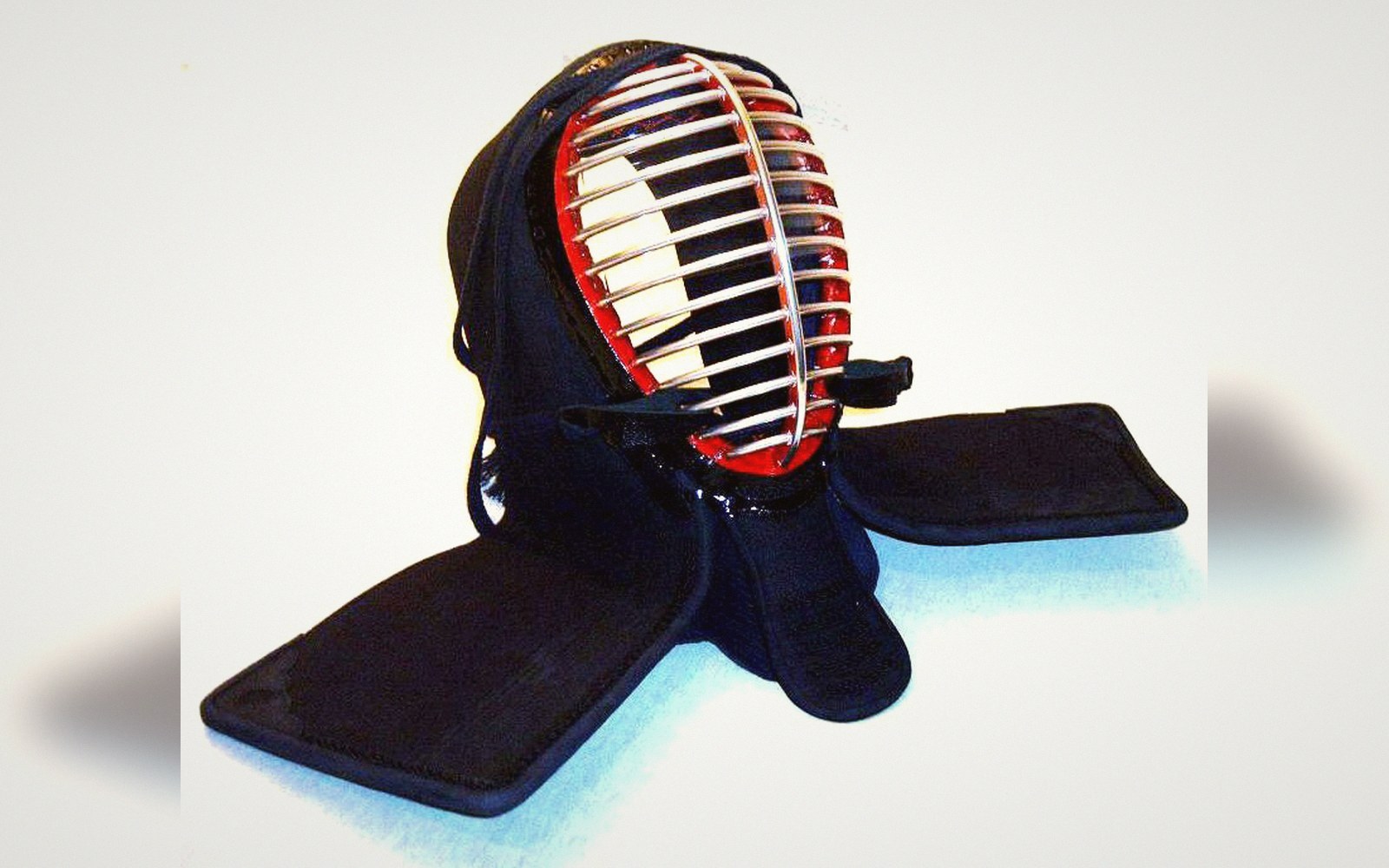
What the grille is doing
The men (面, "helmet") has one job that overrides everything else: stop a shinai strike from reaching the head while transmitting enough sensation that the wearer knows they were hit. That second requirement is the difficult one. A motorcyclist's helmet can absorb freely; a kendo helmet cannot, because total absorption would make the art unworkable. The grille must flex, ring and recover.
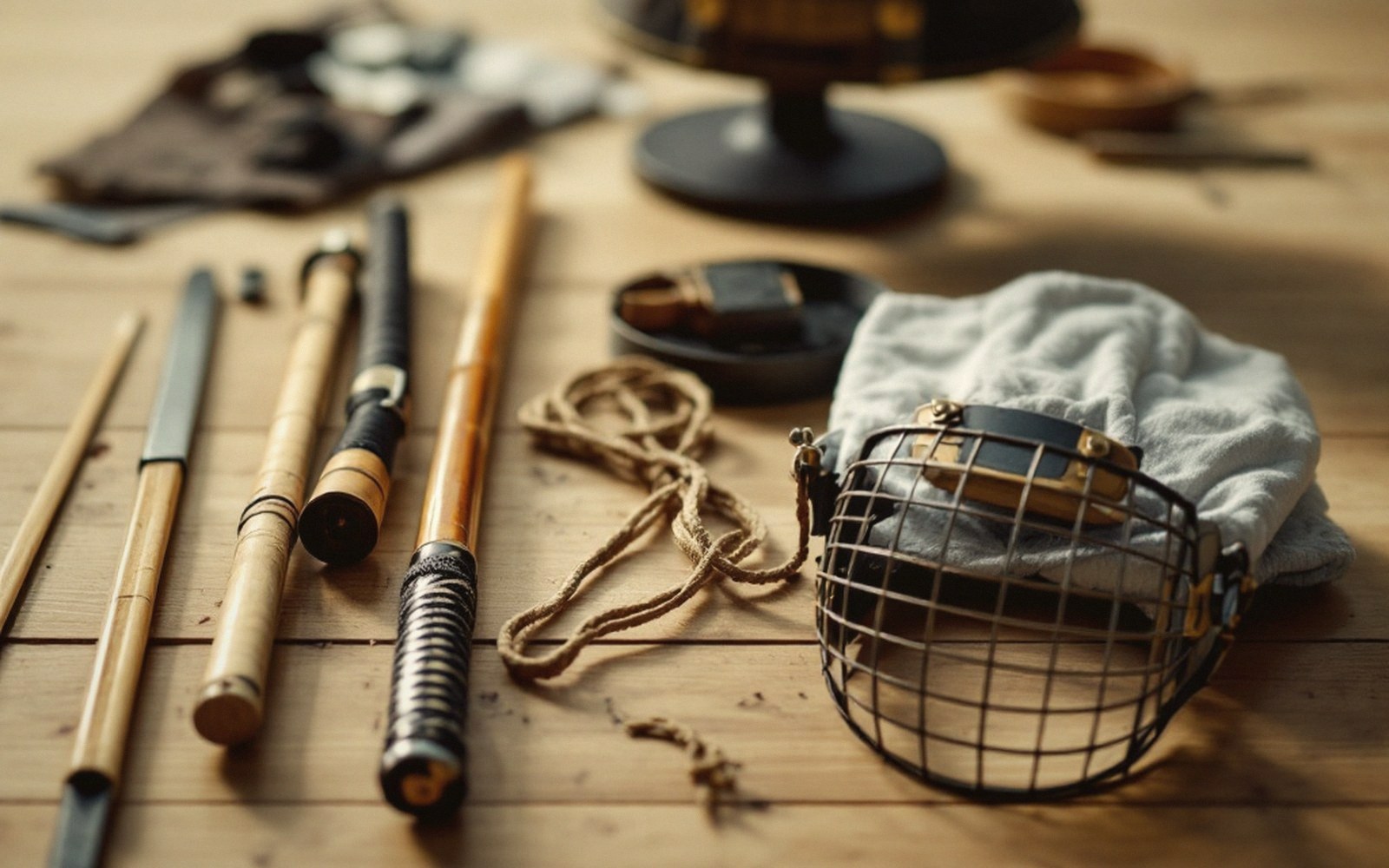
The grille itself — the mengane — is a welded or brazed lattice of steel bars, curved to follow the face and skull. Bar spacing is regulated: the gaps must be narrow enough that a shinai tip cannot pass through and contact the face. The bars run horizontally across the face and vertically or diagonally over the crown, the change in orientation reflecting where strikes land and where structural load travels. Cheaper mengane are pressed from thinner stock and spot-welded; better ones use heavier bar, more welding points and a more carefully engineered curve, so the dome distributes impact rather than concentrating it at the nearest crossbar. You can feel the difference when you press a thumb into the crown: a well-made grille springs back evenly.
The bars are finished — blued, lacquered or coated — not merely for appearance but to stop corrosion at the welds, which is where grilles crack first. If you are stripping and inspecting a men, look there before anywhere else.
The padding that surrounds it
Around the grille runs the menbuchi, a dense padded surround, and then the broad, stitched flanges of the mendare that protect the throat and shoulders. The buchi is where the real energy absorption happens. It sits between the grille's rigid ring and the wearer's head, and it must compress under impact and return to shape before the next blow. The core is typically several layers of cotton wadding compressed and bound, the whole thing covered in leather or synthetic leather and stitched through. The stitching is not decorative: each row of thread locks the wadding in place and prevents it migrating under repeated compression. Stitching that has broken or pulled loose creates a soft patch — the padding redistributes unevenly, and a concentrated strike lands harder on the structure beneath.
The mendare — the wide flaps that fan out from the base of the buchi — are stitched in the same way, with stitching density determining both protection and stiffness. A closely stitched mendare holds its shape under repeated strikes and in high humidity; a loosely stitched one softens and droops, which is not only a fit problem but a protection problem, since a deformed flap no longer presents the same surface area to intercept a strike.
Assembly and fit
The buchi is attached to the grille by a series of lacing points or rivets around the inner ring. This is the joint most worth examining on a used helmet: corrosion works inward from here, and the lacing can abrade through, allowing the buchi to shift slightly with each strike — a tiny movement, but one that compounds over years. A well-maintained joint should show no play. When the buchi is fully secured, the helmet sits on the head with the grille positioned so that the wearer's eyes align with a specific row of bars; a helmet that fits incorrectly in this axis is both uncomfortable and structurally misaligned, since the crown of the grille is where the greatest load should be borne, not the face bars.
The chin and head are secured by the men-himo, a pair of cords that pass through the mendare and tie at the back. Their tension is part of the fit, but the anchor points — grommets or stitched loops in the mendare — take repeated strain and are worth inspecting whenever the helmet is cleaned.
The grille itself — the mengane — is a welded or brazed lattice of steel bars, curved to follow the face and skull.
The men is a made thing, and it shows its making in every part: in the weight of the bar stock, the density of the stitching, the care taken at the joints. All of that is visible before you ever put it on.