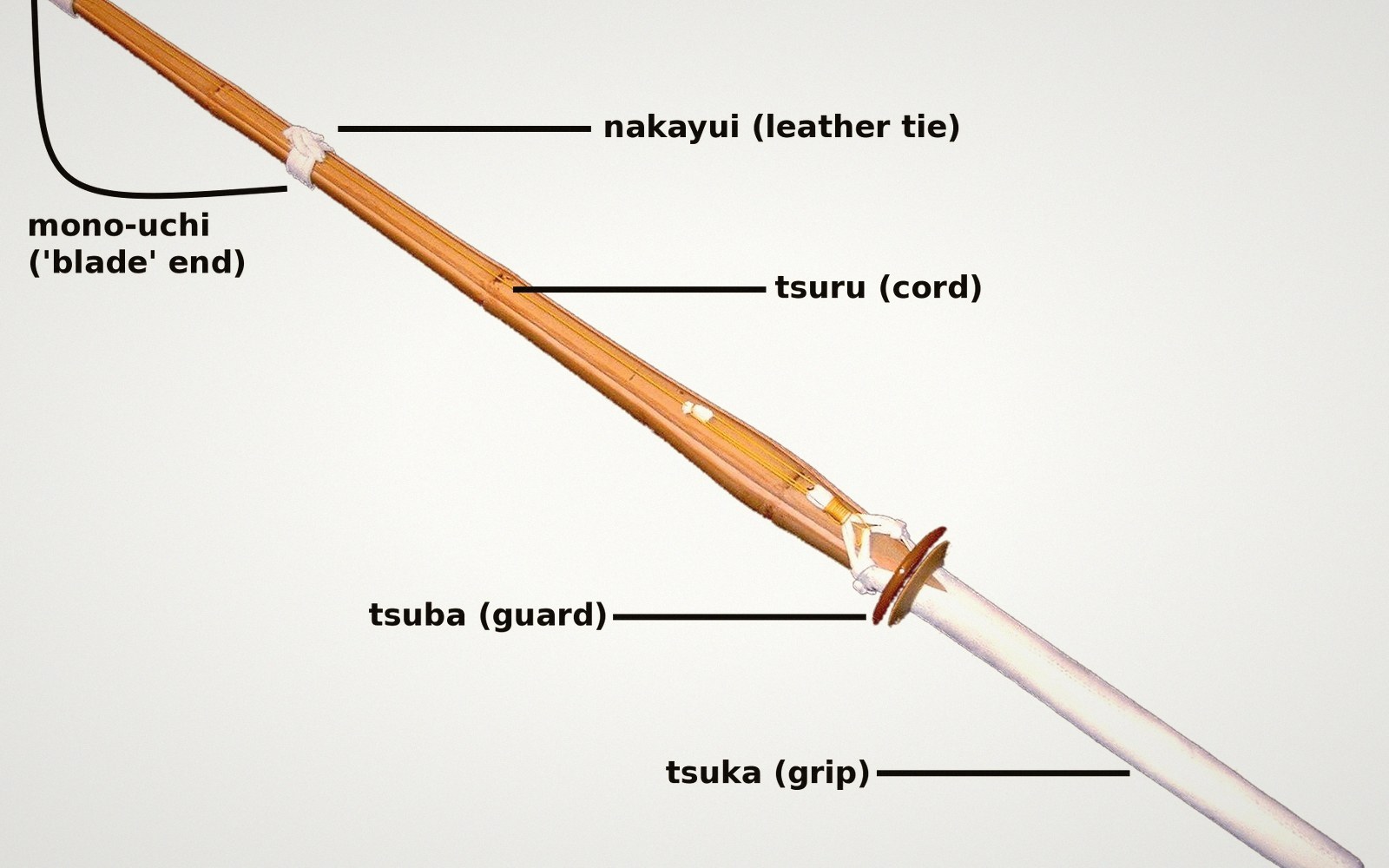
A shinai is not a sword and not a stick. It is four shaped slats of bamboo held in close agreement by three leather fittings and a length of cord — and the character of the whole instrument, how it moves, where it bends, how the tip arrives at a target, comes down largely to the position of a single knot.
Understanding the assembly is the first step toward understanding why anything goes wrong.
The staves themselves
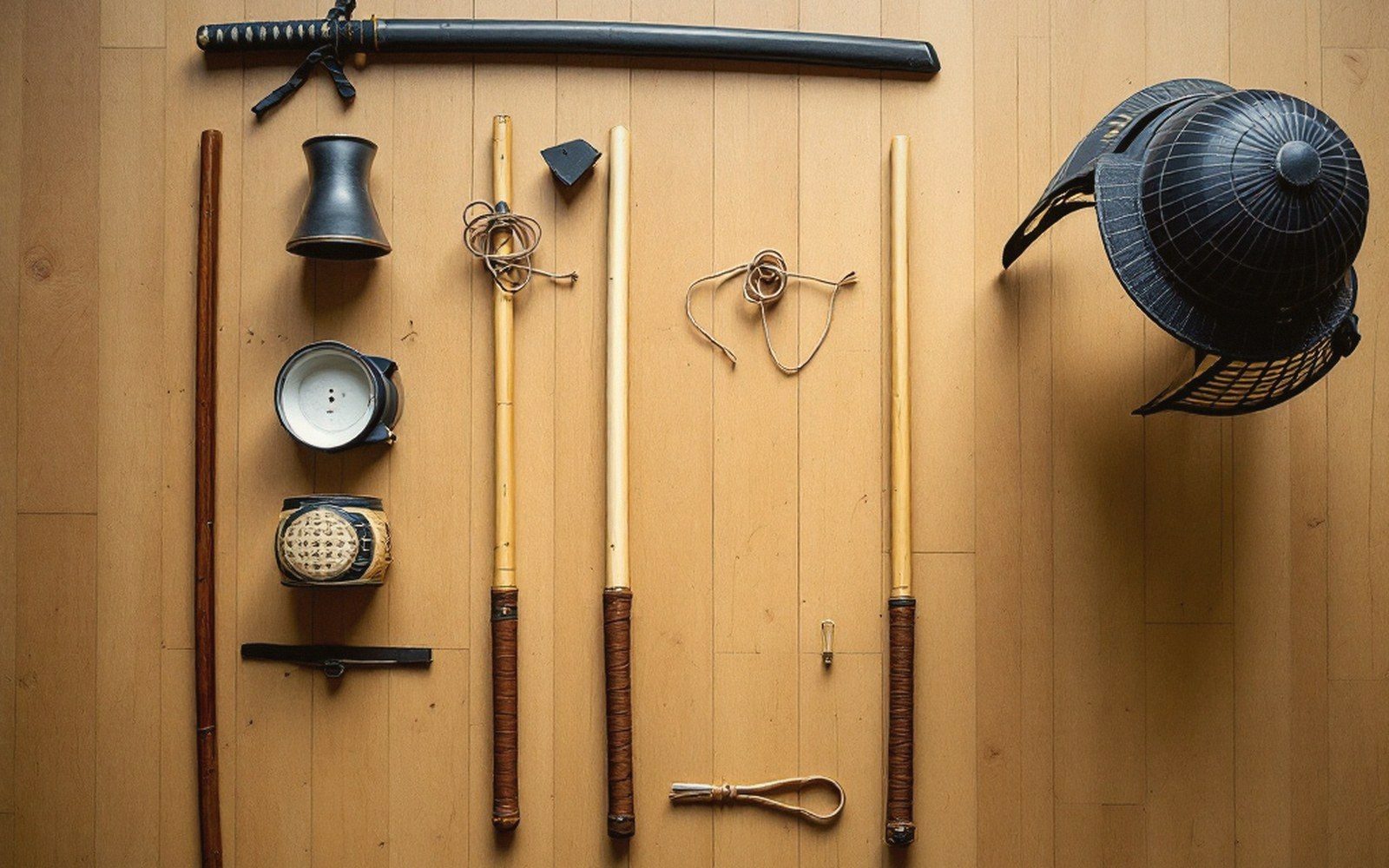
Start with the raw material. The four slats — take (bamboo stave) — are split and shaped from a single round of madake (Phyllostachys bambusoides), the species whose tight fibre and dense outer rind suit the repeated stress of impact better than any substitute yet found. The round is quartered, each piece planed and scraped until the outer surface, the hardest part of the wall, sits on the outside of the assembled shinai. That placement is not incidental: the hardened outer rind takes the abrasion; the softer inner face of the stave, angled inward, contributes flex. A stave reversed — inner face out — wears faster and feels dead.
The four staves are not identical in cross-section. They are slightly domed on the outer face and slightly hollowed or flat on the inner, so that when the four are brought together the assembled shaft is roughly circular with a hollow core. That hollow is what gives the shinai its combination of light weight and stiffness: solid material at the perimeter, air at the centre. The nodes — the hard transverse walls occurring at intervals along every bamboo culm — are staggered between staves rather than lined up, so that no single cross-section is simultaneously at a node in all four pieces. It is a small but deliberate distribution of stiffness.
Three fittings, one cord
At the striking end, a leather sakigawa (tip cap) is pulled over the four staves and holds them together at the point of highest stress. The cap has to fit snugly enough to prevent the staves from spreading on impact and loosely enough to allow the small amount of flex that makes the shinai feel alive rather than rigid. A cap that has hardened, cracked or stretched beyond its seat no longer does either job properly.
Running from beneath the sakigawa down the back of the shaft is the tsuru (cord), a flat or round braid that runs in the groove between the two staves that form the spine — the back of the notional blade. The tsuru terminates at the tsukagawa (grip), the leather sleeve at the handle end that is shrunk or fitted over the lower staves to form the handle. The cord is not decoration and not tradition for its own sake: it defines the spine of the shinai, tells the user by touch which way is up, and its tension is part of what holds the whole assembly under compression along its length. A slack tsuru is a shinai that has begun to come apart.
Between tip cap and grip, the tsuru passes through or beneath a small leather loop, the nakayui — and here is the knot.
The knot and what it does
The nakayui is a short leather strap tied around the shinai at a point roughly one-third of the total length from the tip. The cord passes through the loop; the loop is knotted or wound tight against the shaft. At its position, the nakayui binds the four staves into a single beam and prevents them from separating at that point. Below the nakayui, toward the grip, the staves flex as a unit. Above it, toward the tip, each stave has some freedom of independent movement.
The mechanical consequence is this: by fixing one point along the shaft, the nakayui divides the shinai into two zones of different character. The upper zone — from nakayui to sakigawa — is the flex zone. It is where the four staves can spread fractionally on impact, absorb force, and deliver a blow that has give in it rather than the dead rigidity of a rod. The lower zone, from nakayui to grip, is effectively a handle extension. It transmits, rather than absorbs.
Move the nakayui toward the tip and the flex zone shortens. The shinai becomes stiffer, with a sharper, more direct response. Move it toward the grip and the flex zone lengthens, giving a softer, more whippy instrument with a different feel at the moment of contact. The nakayui's position is not judged by eye and intuition alone; it is measured. For a standard full-length shinai the correct position is specified to within a small margin, because a knot even a centimetre out of place shifts the balance point, alters where the shinai wants to flex, and changes the way the tip behaves. Two shinai of identical length, weight and stave material will feel like different implements if their nakayui positions differ.
This is also why the knot is checked as part of any routine inspection. It loosens with use. A nakayui that has crept toward the tip stiffens the instrument without anyone noticing the cause; one that has worked toward the grip softens it and shifts the flex into a range where the staves are under less constraint at the point of heaviest impact — which is where splinters begin.
The whole as a system
It is worth stepping back and taking the assembly as a single engineered object rather than a list of parts. The four staves supply the structure; the sakigawa at the tip closes and compresses the upper end; the tsukagawa at the lower end does the same at the grip; the tsuru running between them places the whole shaft under longitudinal tension; and the nakayui partway along introduces a controlled fixing point that divides that tension into two zones of deliberately different stiffness. Remove or compromise any one element and the system changes character — not uniformly, but in ways that are predictable once you understand what each component is doing.
The shinai is sometimes described as simple. It has four parts and some leather. But the simplicity is the result of reduction, not of naivety. Every one of those parts is doing more than one job, and the knot partway along the spine is doing the most interesting work of all: it is the adjustment point, the variable, the thing that allows the same four staves to become a range of different instruments depending on where, precisely, you tie it.
Four Staves is an independent publication about kendo equipment and craft. It is not a federation, dojo or retailer, and it does not offer grading, membership or instruction of any kind.